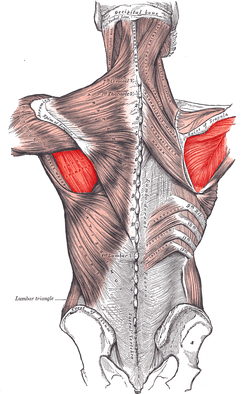
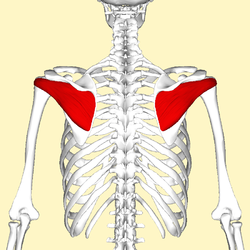
Structure
It attaches medially to the infraspinous fossa of the scapula and laterally to the middle facet of the greater tubercle of the humerus.
The muscle arises by fleshy fibers from the medial two-thirds of the infraspinatous fossa, and by tendinous fibers from the ridges on its surface; it also arises from the infraspinatous fascia which covers it, and separates it from the teres major and teres minor.[1]
The fibers converge to a tendon, which glides over the lateral border of the spine of the scapula and passing across the posterior part of the capsule of the shoulder-joint, is inserted into the middle impression on the greater tubercle of the humerus.[1] The trapezoidal insertion of the infraspinatus onto the humerus is much larger than the equivalent insertion of the supraspinatus, the reason why the infraspinatus is involved in rotator cuff tears about as frequently as the supraspinatus.[2]
Relations
The tendon of this muscle is sometimes separated from the capsule of the shoulder-joint by a bursa, which may communicate with the joint cavity.[1]
Innervation
The suprascapular nerve innervates the supraspinatus and infraspinatus muscles. These muscles function to abduct and laterally rotate the arm, respectively.
Variation
The infraspinatus is frequently fused with the teres minor.[3]
Function
The infraspinatus is the main external rotator of the shoulder. When the arm is fixed, it adducts the inferior angle of the scapula. Its synergists are teres minor and the deltoid.[4]
The infraspinatus and teres minor rotate the head of the humerus outward (external, or lateral, rotation); they also assist in carrying the arm backward.[1]
Additionally, the infraspinatus reinforces the capsule of the shoulder joint.[3]
In animals
From an evolutionary prospective, the pectoral muscles – the pectoralis major and pectoralis minor – are thought to have evolved from a primitive muscle sheet that connected the coracoid to the humerus. In late reptilians and early mammals, this muscle structure was displaced dorsally; while most of its components evolved into the pectoralis major, some fibers eventually attached to the scapula and evolved into the supraspinatus, the infraspinatus, and parts of the subscapularis.[5]
Additional images
| This article uses material from the Wikipedia article Metasyntactic variable, which is released under the Creative Commons Attribution-ShareAlike 3.0 Unported License. |