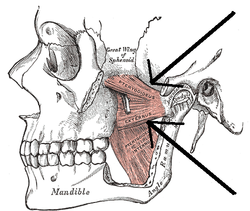
The lateral pterygoid or external pterygoid is a muscle of mastication with two heads. It lies superiorly to the medial pterygoid.

Origin and insertion
The upper/superior head originates on the infratemporal surface and infratemporal crest of the greater wing of the sphenoid bone and inserts onto the articular disc and fibrous capsule of the temporomandibular joint.
The lower/inferior head originates on the lateral surface of the lateral pterygoid plate and inserts onto the neck of condyloid process of the mandible; upper/superior head
Innervation
The mandibular branch of the fifth cranial nerve, the trigeminal nerve, specifically the lateral pterygoid nerve, innervates the lateral pterygoid muscle.
Function
The primary function of the lateral pterygoid muscle is to pull the head of the condyle out of the mandibular fossa along the articular eminence to protrude the mandible. A concerted effort of the lateral pterygoid muscles helps in lowering the mandible and opening the jaw, whereas unilateral action of a lateral pterygoid produces contralateral excursion (a form of mastication), usually performed in concert with the medial pterygoids.
Unlike the other three muscles of mastication, the lateral pterygoid is the only muscle of mastication that assists in depressing the mandible (opening the jaw). At the beginning of this action it is assisted by the digastric, mylohyoid and geniohyoid muscles.
| This article uses material from the Wikipedia article Metasyntactic variable, which is released under the Creative Commons Attribution-ShareAlike 3.0 Unported License. |