The posterior auricular muscle consists of two or three fleshy fasciculi, which arise from the mastoid portion of the temporal bone by short aponeurotic fibers. They are inserted into the lower part of the cranial surface of the concha.
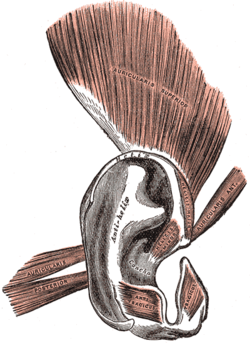

Postauricular reflex
The postauricular reflex is a vestigial muscle response in humans that acts to pull the ear upward and backward.[1] Research suggests neural circuits for pinna orienting have survived in a vestigial state for over 25 million years. It is often assumed the reflex is a vestigial Preyer reflex (also known as the pinna reflex).[2][3]
| This article uses material from the Wikipedia article Metasyntactic variable, which is released under the Creative Commons Attribution-ShareAlike 3.0 Unported License. |