The rhomboid muscles (/ˈrɒmbɔɪd/), often simply called the rhomboids, are rhombus-shaped muscles associated with the scapula. There are two rhomboid muscles on each side of the upper back:[1][2][3]
- Rhomboid major muscle
- Rhomboid minor muscle
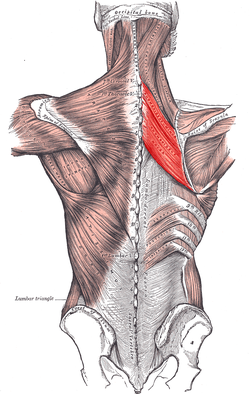
The large rhombus-shaped muscle, located under the trapezius muscle in the upper part of the thoracic region of the back, and also the small muscle, in the same way, participate in the movement of the scapula.[4]
Anatomy
Rhomboid major muscle originates from the spinous processes of vertebrae T2-T5, while it inserts to the medial border of scapula. The rhomboid minor muscle originates from the nuchal ligament and spinous processes of vertebrae C7-T1. Both muscles are innervated by the dorsal scapular nerve, a branch of the brachial plexus. Their functions are the following:[1][2][3]
- Drawing scapula superomedially
- Supporting scapula
- Rotating glenoid cavity inferiorly
Additional images
| This article uses material from the Wikipedia article Metasyntactic variable, which is released under the Creative Commons Attribution-ShareAlike 3.0 Unported License. |